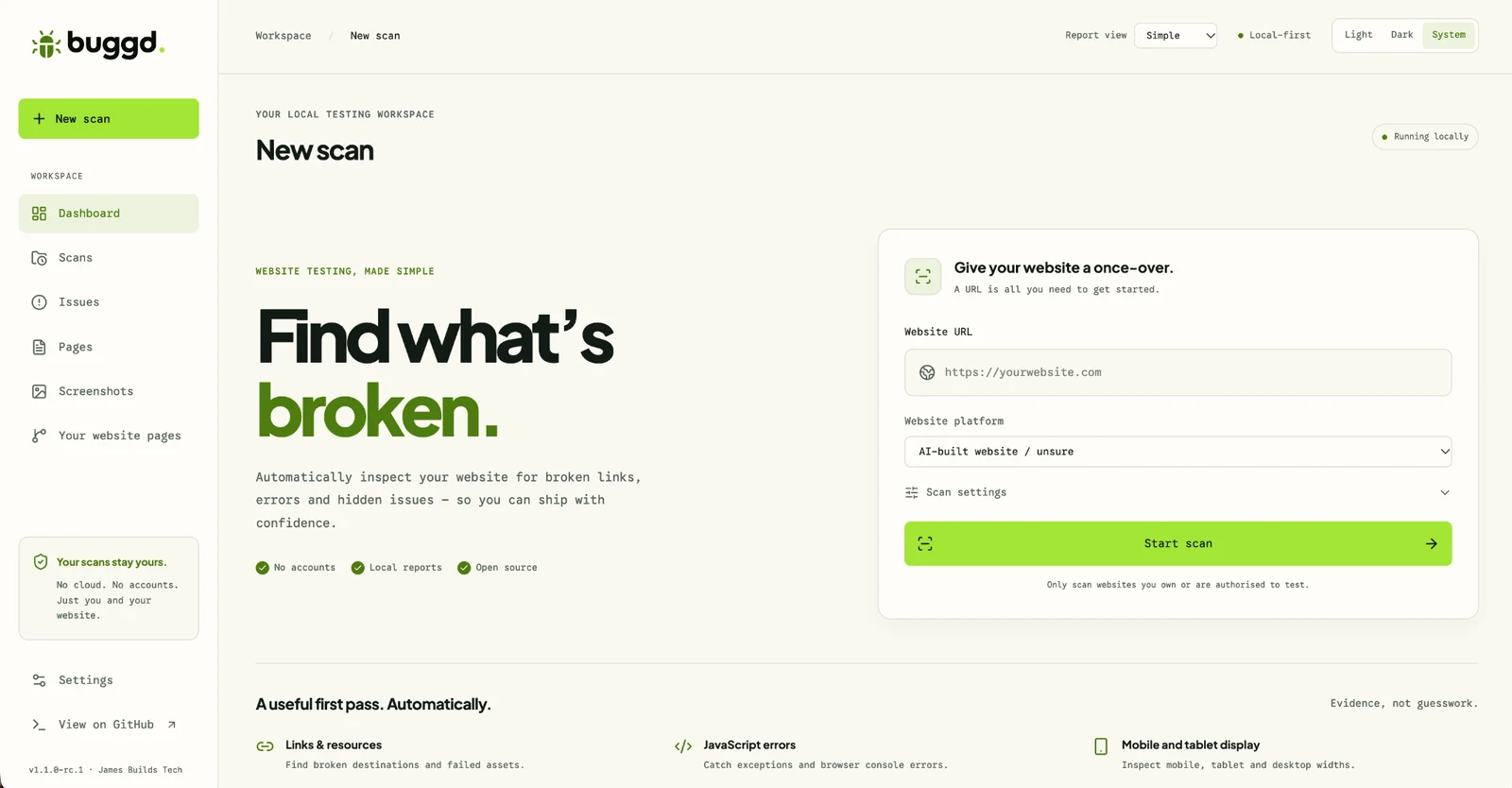
The problem I wanted to solve
Broken links, images that fail to load, JavaScript exceptions and confusing interactive elements can be difficult to track down across a website. Developer tooling often describes the error correctly, but leaves the site owner searching for the affected page or element.
Buggd tries to bridge that gap. A simpler explanation helps someone understand the issue; the underlying browser observation and screenshot give a developer something concrete to investigate. Both views are backed by the same scan, not two different definitions of what went wrong.
Architecture: a local CLI and a real browser
The public npm package is getbugged, launched with
npx getbugged. Its buggd executable starts a
Node.js application with a local Fastify HTTP service and a React/Vite
dashboard. Playwright opens Chromium to inspect pages and capture
evidence. Scans, screenshots and generated reports remain on the user's
machine by default.
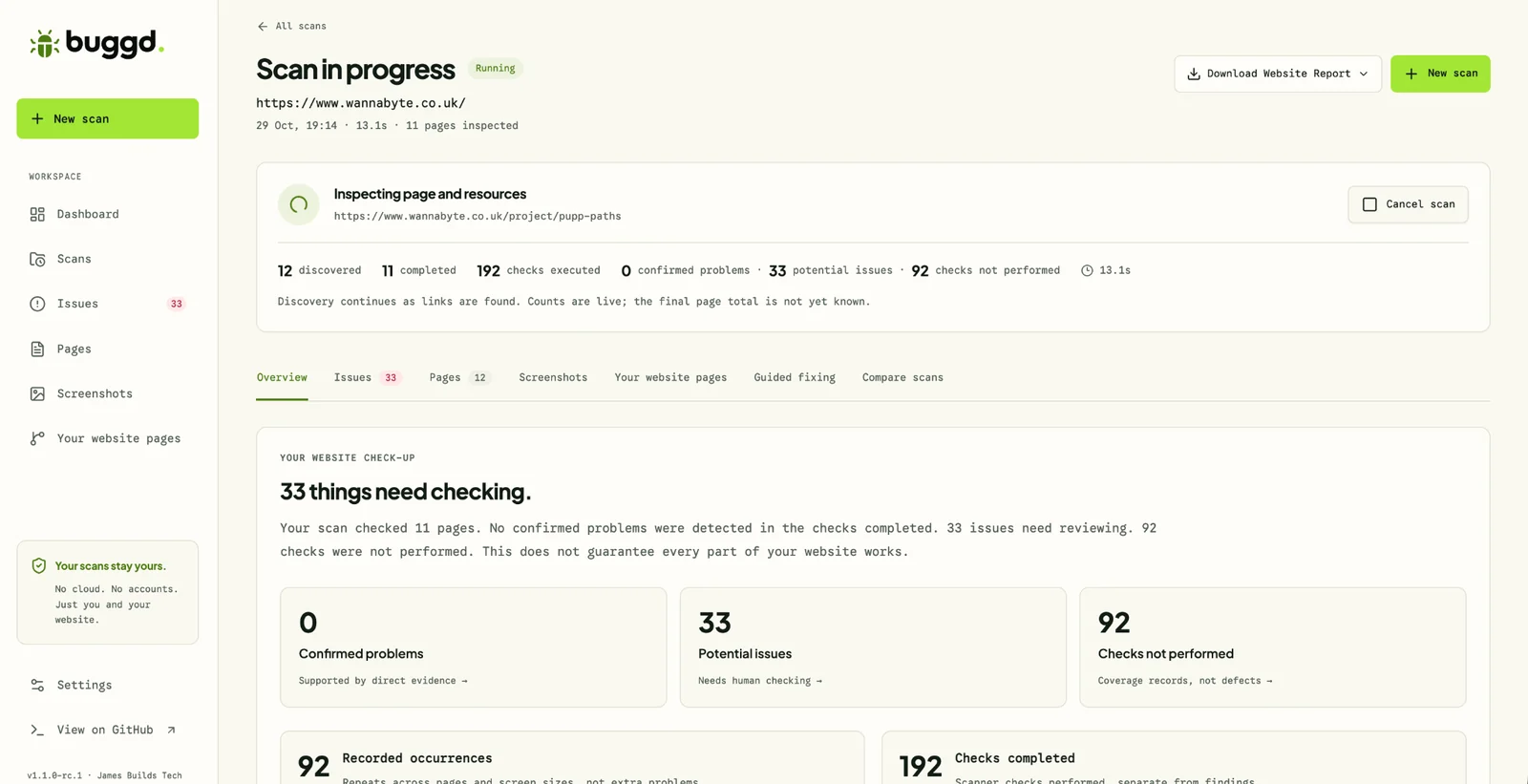
The crawler is deliberately bounded and same-origin. It tracks visited pages and the resources they reference, then records observations from page content, browser console and network activity. The tool separates potential findings from verified failures where evidence is incomplete, rather than implying every warning is definitively broken.
From browser observation to understandable evidence
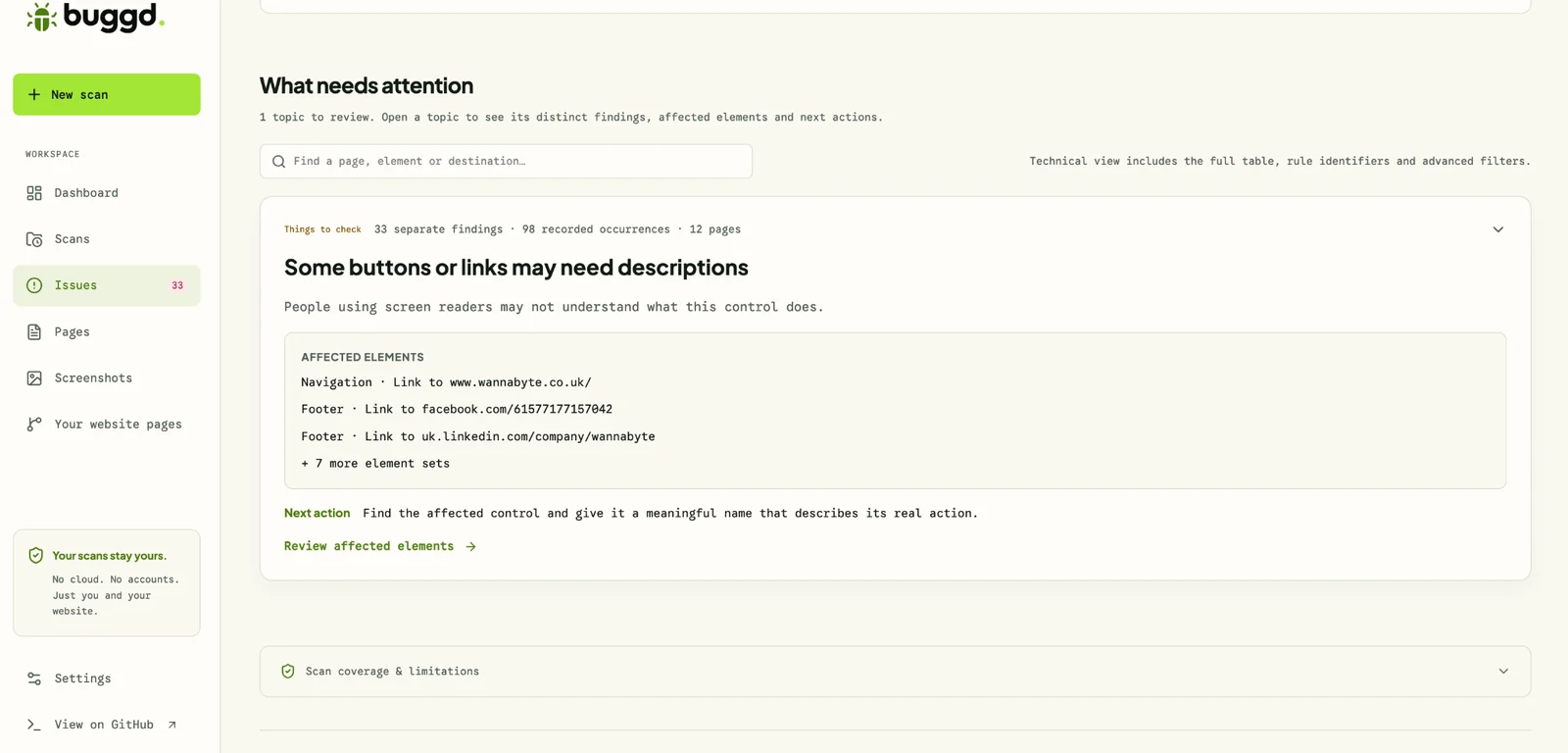
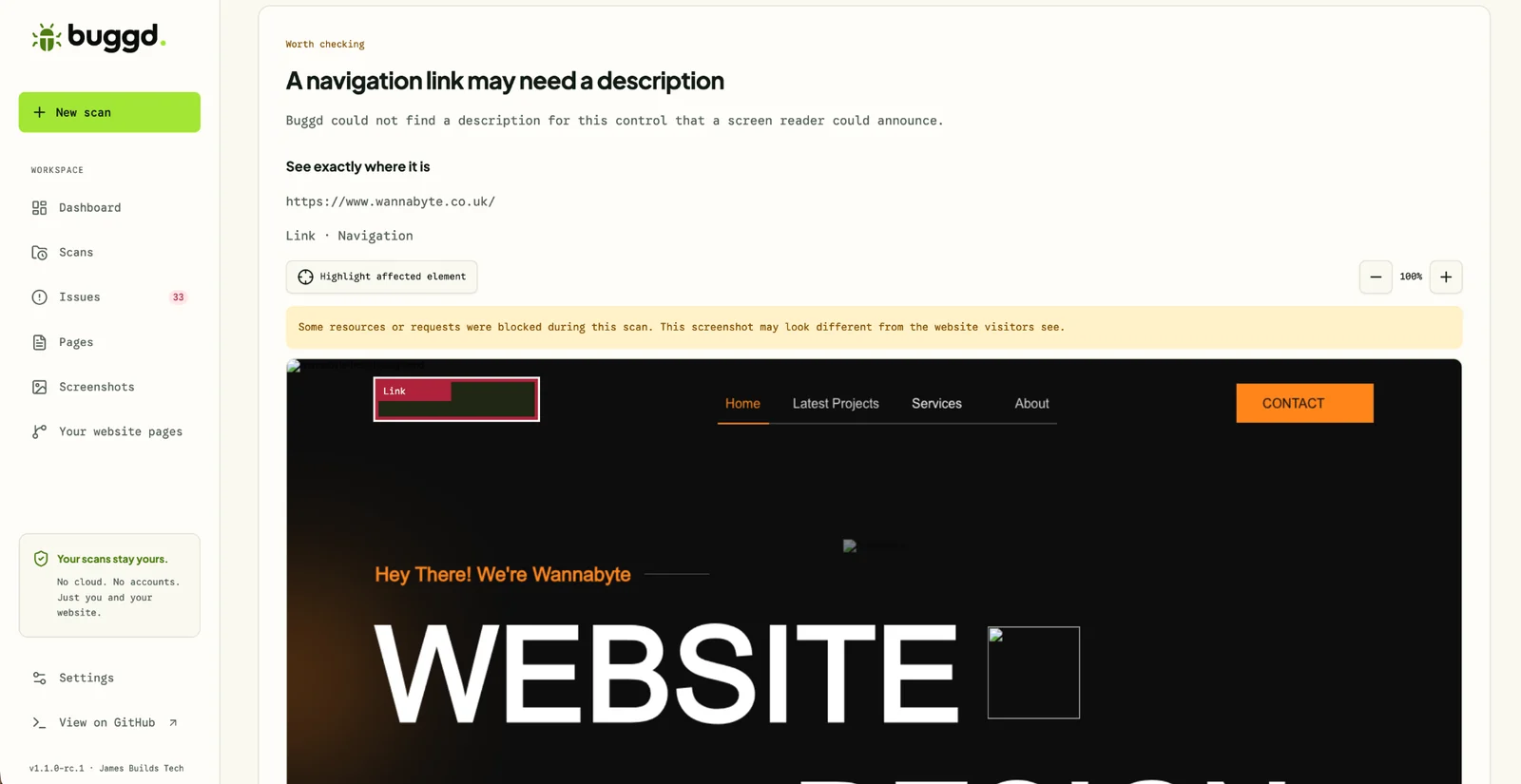
A useful scanner needs to explain where a problem is. Buggd connects issue categories to individual pages, affected elements, captured screenshots and browser-level detail. Its Simple mode presents readable descriptions and next steps; Technical mode exposes lower-level evidence for investigation.
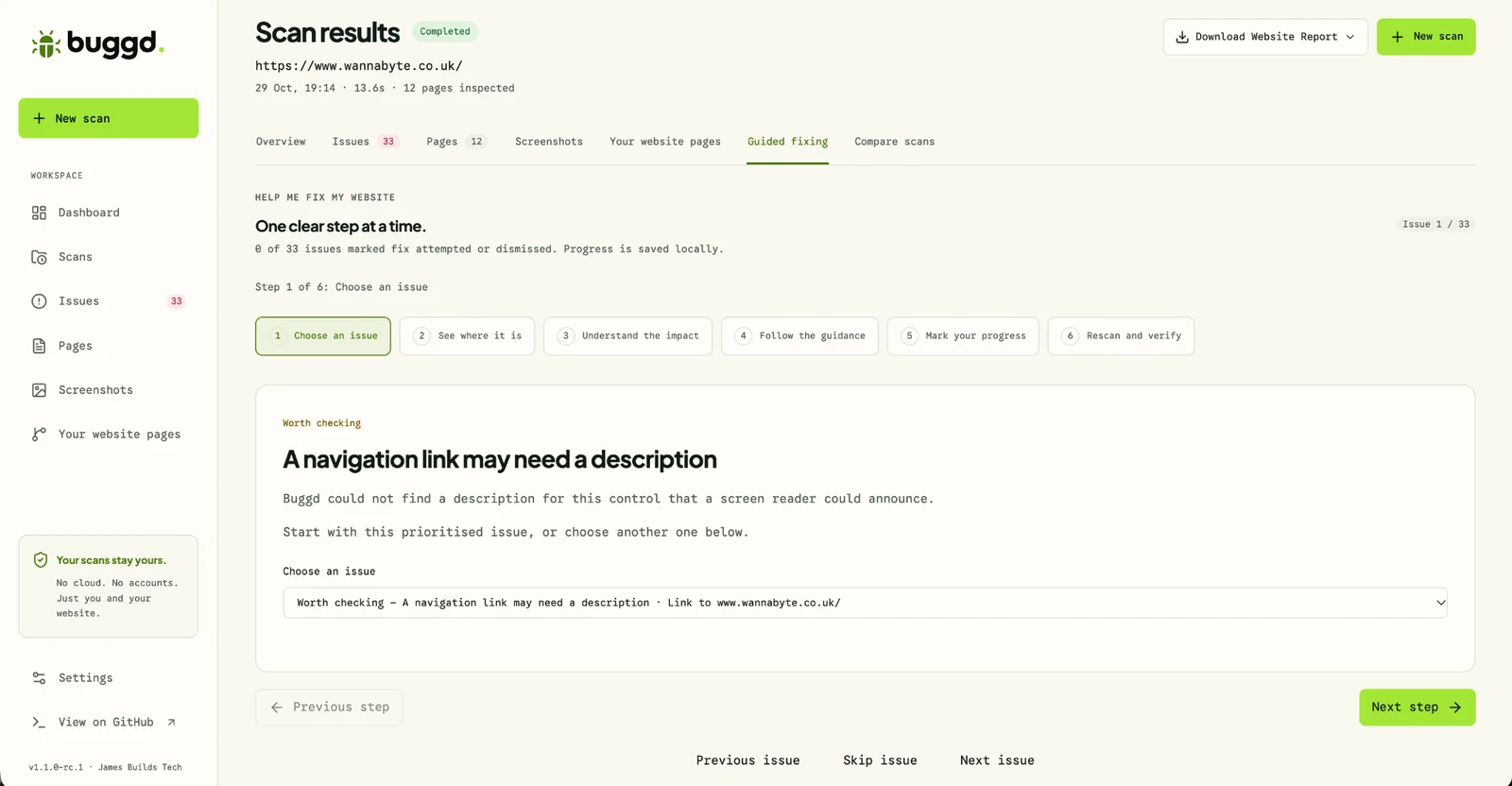
I designed the review workflow so that a proposed fix is not automatically labelled resolved. Users can save their review progress, rescan the site and compare the new observations. If the next scan does not establish that a problem has gone away, Buggd avoids claiming certainty.
Safety was a product requirement, not a footnote
Automated interactions can have real side effects. Buggd deliberately limits its checks to recognised, cautious interactions and native form validation; it does not submit forms or attempt authenticated user journeys. Network access is constrained and scan limits are explicit.
The trade-off is intentional: some dynamic or third-party content will not be fully inspected, and blocked resources can make a screenshot look different from a normal visitor's page. Buggd surfaces those limitations instead of silently presenting a partial scan as comprehensive coverage.
Shipping the first public release
The v1.1.0 release shipped on 7 November 2026 under the MIT licence. The release candidate passed 71 unit/integration tests and 25 browser tests; earlier CI runs covered Windows, macOS and Linux on Node.js 22 and 24. The published npm package was also exercised through a clean public installation and its browser-based scan workflow.
The npm naming process added an unexpected release challenge. The
original unscoped package name buggd was rejected by the
registry's similarity restriction. I kept the product and installed CLI
branded Buggd, but published the distribution as
getbugged.
That distinction kept the code, documentation and release path aligned
without renaming the application.
npx getbugged This is a real first release, not a finished testing platform. It is not a comprehensive security, SEO or accessibility audit, and it will not catch every defect. The next work is to learn from authorised real-world scans, improve first-run clarity and make the evidence easier to act on.
Read the v1.1.0 release notes Review scope and safety limits
The five screenshots are genuine Buggd v1.1 release-candidate captures from an authorised scan of Wannabyte. They were resized and stripped of metadata before publication. Findings and blocked-resource previews should not be confused with how the scanned website normally appears.